Ep 173: An Interactive Neuron and Map Using ThingLink

PlayPlay

Every once in a while a really cool tool comes along and I like to show everyone the fun I had with it. In this video episode I show how I easily made an interactive image of a neuron and an interactive map containing videos and locations for some of the major studies in psychology. Do you know where, for example, “Bobo doll” study was done? How about the spot where “Marion Keech” received her message from the alien race called the “Clarion” which revealed the inner workings of cognitive dissonance? Find out how to make your own fun and easy interactive image in this episode of The Psych Files.
[Read more...]

Ep 171 Psych Files Brief #5: The Allure of Red Dresses, Telling Jokes to Babies, and What a President Looks Like

A whole bunch of fascinating studies in this episode of The Psych Files! I cover the “Red Dress Effect”, what exactly we’re looking for in the facial characteristics of our leaders, how dark rooms might make you more likely to cheat, and how “contagious yawning” really works. Join me on this jaunt down some of the recent and fun research coming out of the fascinating field of psychology.
[Read more...]

Ep 163: Psych Files Brief #4: Animals Smiling, Yogurt De-Stressing, and the Psychology of Success

Do animals smile? Do they feel emotions and if so how many kinds of feelings do they share with us? In this episode we also take a look at the probiotics in yogurt – how do they affect your thinking and do they might help protect you from stress. It turns out that these probiotics increase the production of the neurotransmitter GABA which helps quiet down your neurons. I also talk about the work of female psychologists: Carol Dweck on the psychology of success, and and a tribute to Evelyn Hooker whose research helped in removing homosexuality from the DSM in 1973.
[Read more...]

Episode 138: Zombies – 6 Reasons Why We Are So Fascinated By Them

Image of zombiesAfraid of zombies? Heard about the coming zombie apocalypse? Have you watched the TV show The Walking Dead or ever seen a movie about Zombies (perhaps Zombieland or Dawn of the Dead)?

What is so fascinating about the undead? Why do many of us get a strange pleasure out of seeing a zombie get killed? In this episode I explore that strange part of ourselves which seems to enjoy watching the undead get really dead.


6 Reasons Why We Want To Kill Zombies

  • Freud: we all have an innate aggressive drive. Killing zombies allows for that instinct to express itself. Simple as that.
  • Evolution: We all seem to be fascinated with dead things – dead bugs, car accidents by the side of the road, dead animals, etc., and when you hear about someone dying you always want to know why and – admit it – you wonder a bit if that’s something that might happen to you. From an evolutionary perspective one might suggest that as we evolved, those of us who weren’t curious about why other creatures died probably didn’t survive. Those who were fascinated by dead things learned how to avoid being dead. Thus, curiosity about dead things is probably built right into us.
  • Social Roles: Every day we restrain ourselves from expressing our true emotions. Perhaps our desire to kill zombies is an expression of our desire to break out of our roles for just a short while, to express feelings – aggressive ones – that we normally must keep inside. Clint Eastwood once said that the reason why people like his films is because he says things to people and he does things that we all wish we could, but we don’t because we can’t – because there are laws and social rules we must follow that he doesn’t.
  • .

  • Just World Belief and Tolerance for Ambiguity (or the lack thereof): the existence of the undead make everything easy: they are clearly the “bad guys”. There’s nothing complicated here – nothing grey. The undead deserve to die and killing them really isn’t wrong because they’re dead anyway.

  • Fear of Scientific progression: (ex: nuclear bombs, Godzilla, etc.):
  • Film-goers have always loved a good scare, and a shambling collection of neuron-challenged corpses make a pretty terrifying story. And if my zombie-obsessed 14-year-old son is a representative sample, blowing the undead away with heavy weaponry has a solid adolescent demographic appeal. But there’s no question, at least in my mind, that zombies (and Godzilla) are an allegorical representation of our fear that science and the technologies it spawn will lead to our destruction. – James Turner, Forbes Magazine article

  • Terror Management: zombies are reminders of our own mortality which we don’t want to be reminded of, so we kill them in a symbolic way of overcoming death.
  • From Jeff Greenberg, researcher on Terror Management Theory:

    People are fascinated by phenomena such as ESP, psychokinesis, communicating with the dead, ghosts, vampires, and zombies in part because [they] allow for the possibility of some essence or aspect of us surviving beyond death. One could speculate that these forms of the supernatural are growing in popularity, along with their positive counterparts, superheroes, because of lessened faith in traditional religious conceptions of the supernatural…

    Zombies also deny the finality of death – here are these beings who are functioning after they have died. It’s not a pretty afterlife, but if this is possible, better forms may also be out there.

    …because zombies are “already dead” we can be guilt free and gleefully watch them killed in every way possible no matter how grisly, vicariously aggressing against this substitute source of our fears with complete abandon.”

Better grades on your psych tests!

The psychology test preparation app

Stay Up-To-Date on Psychology!

The psychology news app

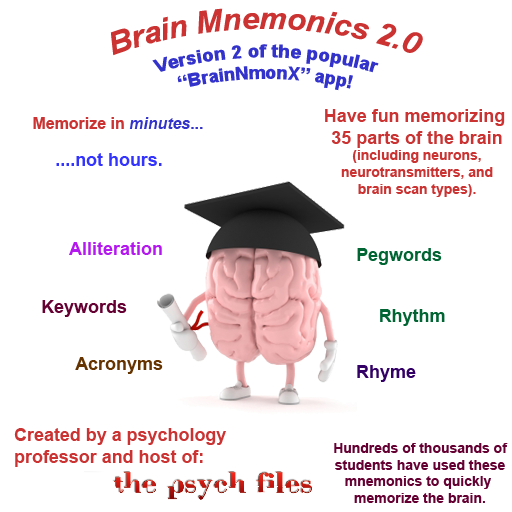
Quickly Memorize the Brain!

The Brain Mnemonics app and eBook

What is Psychology All About?

The Psych Guide app for iOS and Android

Episode 132: Opera on the Brain

What part of your brain is lighting up when you’re singing? In this episode I take a look at a neat new study that involved having singers lie down in an MRI while their brains were scanned. Take a look at how your cerebellum, your parietal lobe your somato-sentory cortex and your amygdala are all involved in your ability to sing. I’ll also look at how mental rehearsal can positively affect how well you perform a task.

  • Kleber, B., Veit, R., Birbaumer, N., Gruzelier, J., & Lotze, M. (2009). The Brain of Opera Singers: Experience-Dependent Changes in Functional Activation. Cerebral Cortex, 20 (5), 1144-1152.
  • Cerebral Cortex
  • Zarate, J.M. and Zatorre, R.J. (2008). Experience-dependent neural substrates involved in vocal pitch regulation during singing. NeuroImage, 40, 1871–1887.
  • Kleber, B. Birbaumer, N., Veit, R. Trevorrow, T. and Lotze, M. (2007). Overt and imagined singing of an Italian aria. NeuroImage, 36, 889-900.
  • Buonomano DV, Merzenich MM. 1998. Cortical plasticity: from synapses to maps. Annu Rev Neurosci. 21:149-186.
  • Elbert T, Pantev C, Wienbruch C, Rockstroh B, Taub E. 1995. Increased cortical representation of the fingers of the left hand in string players. Science. 270:305-307.
  • Gunji A, Ishii R, Chau W, Kakigi R, Pantev C. 2007. Rhythmic brain activities related to singing in humans. Neuroimage. 34:426-434.
  • Nielsen JB, Cohen LG. 2008. The Olympic brain. Does corticospinal plasticity play a role in acquisition of skills required for high- performance sports? J Physiol. 586:65–70.
  • Opera singing in the brain scanner